
What Is a Good ROAS on Amazon? Start With Your Margin
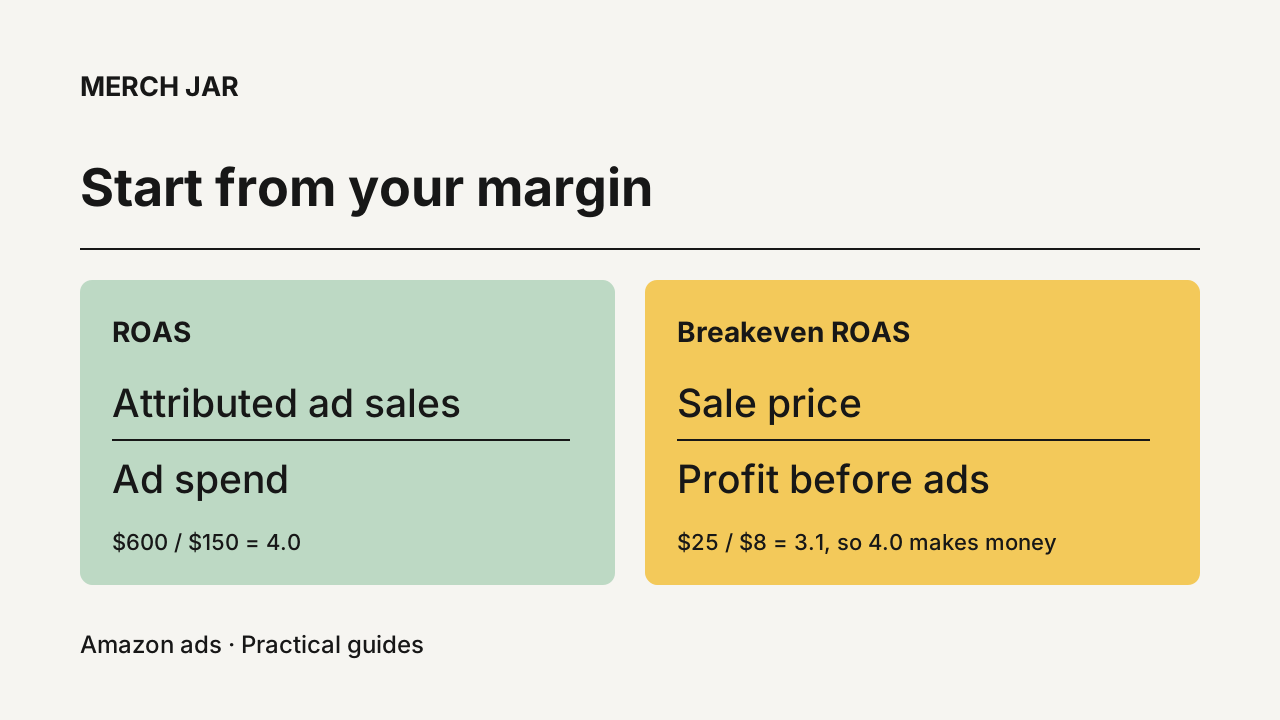
ROAS is your attributed ad sales divided by your ad spend. Amazon reports both ROAS and ACoS, and the two carry the same information inverted, so a 4.0 ROAS and a 25% ACoS are one result written two ways. A good ROAS is any number above your breakeven ROAS, which is 1 divided by your margin before ad spend, or your sale price divided by your profit per unit before ads. You work that out from your own costs in about a minute, and it’s the only benchmark that tells you whether the order made money.
The formula, and what Amazon counts
Amazon’s own definition is the revenue from an ad campaign divided by the amount spent on that campaign.
$600 attributed ad sales / $150 ad spend = 4.0 ROAS
The word doing the work there is attributed. Amazon counts the sales it credits to your ads and nothing else, so every organic order you got that month sits outside the number entirely. Attribution also runs on a window after the click, which is why a recent date range keeps filling in for a while after you first look at it. Amazon’s attribution guidance says a report date stays incomplete until its lookback window ends. Those two things together are the usual reason the figure in your console doesn’t match the one in your spreadsheet.
ROAS and ACoS are the same division, flipped
ACoS divides spend by sales. ROAS divides sales by spend. One is the reciprocal of the other, and you can move between them without any extra data.
ROAS = 1 / ACoS
ACoS = 1 / ROAS
Amazon prints ACoS as a percentage and ROAS as a multiple, which is why the same campaign reads 25% in one column and 4.0 in the next one over with nothing wrong.
| ACoS | ROAS |
|---|---|
| 10% | 10.0 |
| 20% | 5.0 |
| 25% | 4.0 |
| 33.3% | 3.0 |
| 50% | 2.0 |
If you came to Amazon from Google Ads, or from an agency report where ROAS is the native number, that table is most of the translation you need. The ACoS to ROAS calculator converts in both directions if you’d rather not do the division.
Breakeven ROAS comes out of your margin
Take a product that sells for $25. Amazon takes $7 in referral and fulfillment fees, your cost of goods is $10, and $8 of profit is left before you’ve spent anything on ads.
$25 sale price - $7 Amazon fees - $10 COGS = $8 profit
$25 sale price / $8 profit = 3.125 breakeven ROAS
Call it 3.1. At exactly 3.1 the ad eats the whole $8 and you net zero on the unit. At a 4.0 ROAS the ad costs $6.25 of that $25 order and you keep $1.75. At 2.5 the ad costs $10 and you’re $2 down on every order, which is either a launch decision or something you haven’t noticed yet.
Benchmarks like “aim for 4:1 to 7:1” float around the seller internet, and they can’t be right for everyone, because they never ask what the product earns. A 60% margin product breaks even at a 1.7 ROAS, so 4.0 there is solidly profitable. A 20% margin product needs 5.0 just to reach zero, so that same 4.0 loses money on every order. Same 4.0, and the answer depends entirely on the margin sitting behind it.
So good is something you decide per product once you know that line. Run your sale price, fees, and cost of goods through the breakeven ACoS calculator, then divide 1 by the percentage it gives you for the ROAS version. The break-even ROAS calculator does that division for you. Where to set your target above that line depends on what the product needs right now, which is the job of our guides to a good ACoS and choosing your target ACoS. Bids follow from the target, and that math is in the keyword bidding walkthrough.
What ROAS doesn't show you
Ads on Amazon do a second job that ROAS has no way to measure. Sales velocity feeds keyword rank, rank feeds organic orders, and those organic orders never enter the ROAS calculation at all, so a campaign can look mediocre on ROAS while quietly building the organic base underneath it. The metric that catches this is TACoS, which puts every sale in the denominator instead of only the attributed ones. We wrote up how TACoS works and what its trend means separately.
The other blind spot is one you choose. A launch often runs below breakeven ROAS for weeks on purpose, because early on you’re buying reviews and rank rather than margin. The good ACoS guide covers when that stops being a strategy.
Quick answers
What is ROAS on Amazon?
Return on ad spend. Your ad-attributed sales divided by your ad spend, shown as a multiple. $600 in attributed sales on $150 of spend is a 4.0 ROAS, so four dollars of ad-attributed revenue came back for every dollar spent.
Is a ROAS of 3 good?
Depends on your margin before ads, and nothing else. On the $25 product above, breakeven is 3.1, so a 3.0 is a small loss on every unit. On a product carrying a 40% margin, breakeven is 2.5 and a 3.0 makes money. Work out your own breakeven before you judge any ROAS number. The ROAS calculator does both from your revenue, ad spend and margin.
ROAS or ACoS, which should I use?
Same information either way, so use whichever one your brain converts faster. Amazon-native sellers tend to think in ACoS, because a percentage compares directly against a margin percentage. If your reporting or your agency already speaks ROAS, stay in ROAS and convert when you need to.
Why does Amazon show a different ROAS than my spreadsheet?
Usually because the two aren’t counting the same sales. Amazon’s ROAS uses ad-attributed revenue only, so a spreadsheet dividing total sales by ad spend is showing you the inverse of TACoS instead, which will always look better. Timing accounts for most of the rest, since attributed sales keep landing against a click that already happened.
Put your own numbers in
Grab your sale price, the Amazon fees off a recent order, and your cost of goods. One division gives you a breakeven ROAS, and everything after that is a decision about how far above it each product should run. The breakeven calculator and the ACoS to ROAS calculator handle the arithmetic.
Once you have targets, you can set a target ACoS at any level in Merch Jar, account, campaign, ad group or keyword, and have rules watch performance against it. 14-day free trial, no credit card.