
Amazon Keyword Bidding Strategy That Starts From Your Margin, Not Amazon's Suggestion
Every keyword bid is an answer to one question. What's the most a click on this search can cost before it stops being worth buying? Amazon's suggested bid doesn't know your margin or your conversion rate, so it can't answer that. You can, with three numbers you already have.
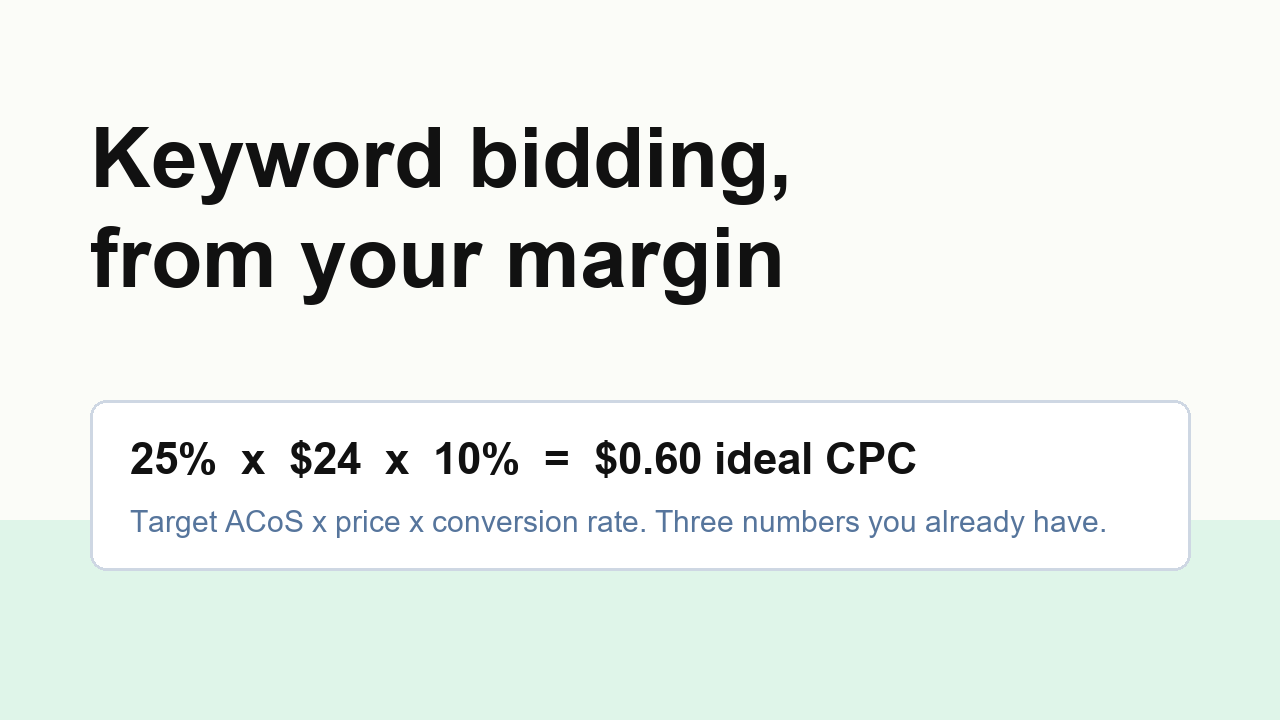
Target ACoS x price x conversion rate = your ideal CPC
25% x $24 x 10% = $0.60
On that product, sixty cents is the bid where hitting your target ACoS is the expected outcome. Everything else in bidding strategy is refinements on this number.
Get the three inputs
Your target ACoS comes from your margin and your goals for the product, aggressive for launches, conservative for profit. That derivation is its own guide (choosing your target ACoS), so here we'll take 25% as given.
Price is your average selling price. Conversion rate is unit session percentage from your business reports, or orders divided by clicks from your ads console for a keyword that already has history. If a keyword has no history yet, use the product's overall rate and let real data correct it later.
So a $24 product converting at 10% with a 25% target supports a $0.60 CPC. The same product converting at 5% supports $0.30. Notice how hard conversion rate moves the answer, doubling it doubles your affordable bid, which is why the same keyword deserves different bids on different products. Run your own numbers in the target CPC calculator.
One thing this number is not. It's a bid ceiling derived from your economics, and actual CPCs usually land under the bid, so treat it as the top of your range, opening bids a notch below it are the safer start.
Adjust on data, not on mood
After two or three weeks of real traffic, keywords sort themselves into buckets, and each bucket has an obvious move.
Converting under your target ACoS. Raise the bid 10-15% and see if there's cheap volume above you. A keyword at 15% ACoS against a 25% target is leaving impressions on the table.
Converting over your target. Lower the bid toward what the math supports. The formula works in reverse, actual sales-per-click divided by your target gives the corrected bid. A keyword producing $1.60 in revenue per click at a 25% target supports $0.40, and if it's currently bid at $0.70, that's your cut.
Clicks and no orders. Bidding lower is usually the wrong tool here, the keyword either needs more data, a better-matched listing, or a negative. Our ACoS guide covers the breakeven line these calls hinge on.
Small moves, on a schedule, beat big reactive ones. CPCs shift with competition and season, so a weekly or biweekly pass at 10-15% per adjustment tracks the market without whiplashing your rank. And Amazon's dynamic bidding adjusts off whatever base bid you set, so a wrong base gets amplified, not fixed.
Where dynamic bidding fits
Amazon layers its own adjustment on top of whatever base bid you set. With "dynamic bids - down only," Amazon lowers your bid in auctions it judges less likely to convert. With "up and down," it also raises your bid in likely-to-convert auctions, by up to 100% for top-of-search placements. Placement adjustments stack on top of that, letting you bid a percentage more for top-of-search or product pages specifically.
The practical read on all of it. These multipliers amplify your base bid, they never fix it. A base bid 2x what your economics support, run through up-and-down, can produce clicks at 3-4x your affordable CPC in premium placements. Get the base right from the formula first, run down-only or fixed while a keyword is unproven, and consider up-and-down for keywords with enough history that Amazon's conversion predictions have something real to work from.
Common bidding questions, answered short
What should my starting bid be?
A notch under your ideal CPC from the formula. For the $24 product at a 10% conversion rate and 25% target, that's an opening bid around $0.50-0.55 against the $0.60 ceiling, leaving room for placement multipliers.
Should I use Amazon's suggested bid?
As a market signal, yes, it tells you roughly what winning impressions costs right now. As your actual bid, no, it knows nothing about your margin. When the suggested bid sits far above your ideal CPC, that's not a prompt to bid higher, it's information that this keyword's auction is too expensive for this product's economics.
How often should I adjust bids?
Weekly or biweekly, in 10-15% steps, on keywords with enough new data to justify the move. Daily bid-fiddling reacts to noise, monthly is slow enough to bleed on a bad bid for weeks.
Put guardrails on it before you scale it
Once you're managing hundreds of keywords, a fat-fingered bid or a runaway rule costs real money before you notice. Set explicit floors and ceilings per keyword or per campaign and treat them as the boundary your bidding logic operates inside. In Merch Jar these exist as Bid Limits, min and max guardrails that cascade from account default down to individual keywords, so every automated or bulk change stays inside a range you chose. And the adjustment passes above, raise the efficient ones, correct the expensive ones, on your schedule with your thresholds, are exactly what Workflows automate using your own numbers as inputs. 14-day free trial, no credit card.
Start with the formula on your ten highest-spend keywords this week. Most sellers find at least one bid that's 2x what the math supports.