
What Is a Good ACoS on Amazon?
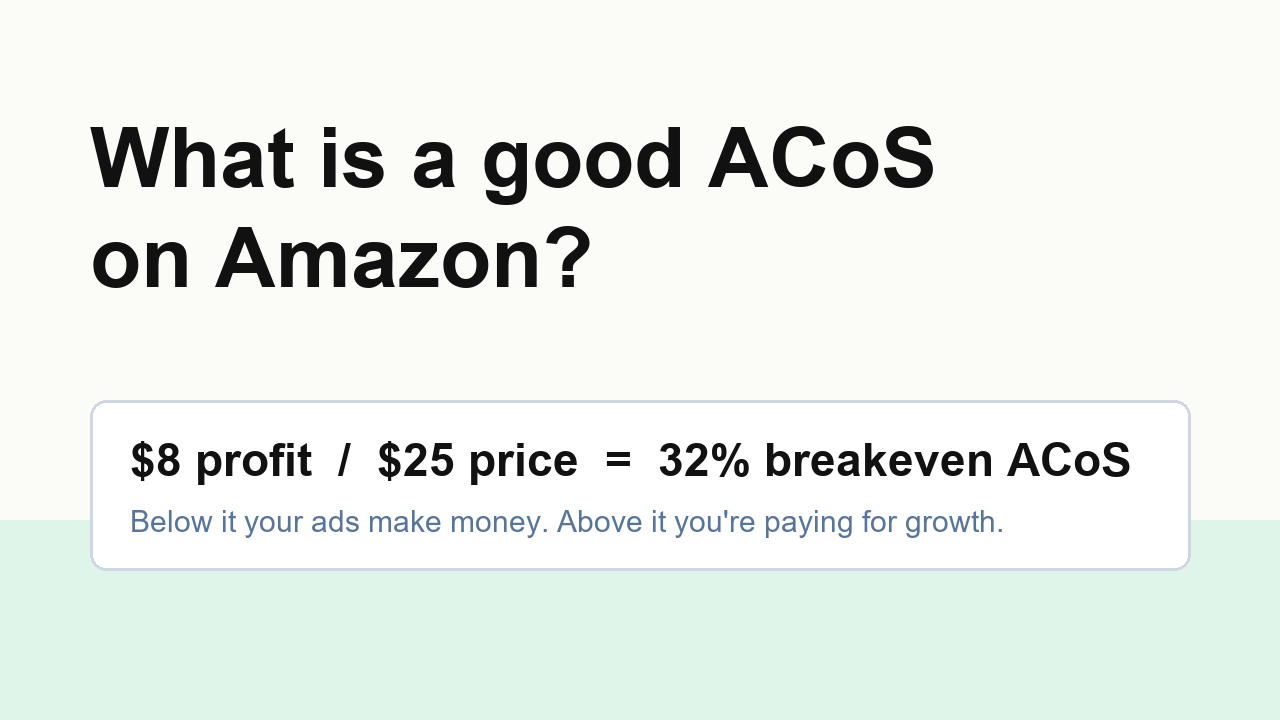
Short answer, there is no universal good ACoS. A 40% ACoS can be great for one product and a disaster for another. The number that actually decides it is your breakeven ACoS, which is just your profit margin before ad spend. Below breakeven, your ads make money on every sale. Above it, you're paying for growth. The math takes about a minute, and this article walks through it with real dollars.
What ACoS actually measures
ACoS stands for advertising cost of sales. It's your ad spend divided by the sales those ads generated.
$150 ad spend / $600 ad sales = 25% ACoS
Lower means more efficient. If you're used to ROAS, it's the same information flipped upside down. That $600 in sales on $150 of spend is a 4.0 ROAS. Amazon reports ACoS, most other ad platforms report ROAS, and the two convert directly (we have a free ACoS to ROAS calculator if you'd rather not do the division).
One thing worth being precise about. ACoS only counts sales attributed to your ads, not your organic sales. That distinction matters later when we get to TACoS.
Find your breakeven ACoS first
Your breakeven ACoS is the point where an ad sale makes you exactly zero dollars. It equals your profit margin before any ad spend.
Say you sell a product for $25. Amazon takes $7 in referral and fulfillment fees, and your cost of goods is $10. That leaves $8 of profit per unit.
$25 sale price - $7 Amazon fees - $10 COGS = $8 profit
$8 profit / $25 sale price = 32% margin = 32% breakeven ACoS
So on this product, a 32% ACoS means every ad-attributed sale nets you nothing. At 25% ACoS you keep $1.75 per ad sale. At 40% you lose $2 per ad sale, on purpose or not.
That's the whole trick. "Is 35% a good ACoS" is unanswerable in general and trivial once you know your margin. A supplement brand with 60% margins can run a 45% ACoS profitably. A phone-case seller at 20% margins loses money at half that. Run your own numbers through the breakeven ACoS calculator and you have your line.
Good depends on what the product needs right now
Once you know your breakeven, "good" is a decision, not a benchmark.
A new product with no reviews usually justifies an ACoS at or above breakeven. You're buying reviews and sales velocity, and the margin you give up is the cost of that. Plenty of launches run deliberately unprofitable ads for weeks.
A mature product with steady organic sales is the opposite case. There you want ACoS comfortably below breakeven, because the job of those ads is profit, not growth. Somewhere in between sits most of your catalog.
So instead of asking whether your ACoS matches an industry average, pick a target ACoS per product based on its goals, then manage toward it. We wrote a separate guide on choosing your target ACoS that goes deeper on the aggressive-to-conservative spectrum.
TACoS tells you if the strategy is working
ACoS judges your ads in isolation. TACoS (total advertising cost of sales) divides the same ad spend by ALL your sales, organic included.
$150 ad spend / $2,000 total sales = 7.5% TACoS
Why track both? Because ads on Amazon do two jobs. They generate attributed sales, which ACoS sees, and they push sales velocity and keyword rank, which shows up later as organic orders ACoS never sees.
The pattern worth watching is TACoS falling while ACoS holds steady. That means organic sales are growing faster than ad spend, which is what a healthy launch matures into. If TACoS keeps climbing month after month on a mature product, your total business is getting more dependent on paid traffic, and that's worth a hard look at your bids and targets even if ACoS alone looks fine.
Why ACoS varies so much inside one account
Even with a single target, your actual ACoS will spread wide across campaigns, and most of that spread is structural, not a performance problem.
Match types run at different efficiencies. Exact match keywords you've already proven tend to run the tightest ACoS, broad match and auto campaigns run looser because part of their job is finding new search terms, and that discovery has a cost. Placements differ too. Top-of-search clicks cost more than product-page clicks, so a campaign winning premium placements can carry a higher ACoS with the same conversion rate.
Product age might be the biggest one. A three-week-old listing with four reviews converts a fraction of what it will at fifty reviews, and conversion rate sits directly inside the ACoS math. The same keyword, same bid, same traffic can run 60% ACoS at launch and 25% six months later without you touching anything. Judge campaigns against their own job, not against each other.
Quick answers on the basics
What does ACoS stand for?
Advertising cost of sales. Ad spend divided by ad-attributed sales, expressed as a percentage. $150 spent, $600 in ad sales, 25% ACoS.
What's the average ACoS on Amazon?
Published averages float around the industry, and none of them should change what you do. An average blends supplement margins with phone-case margins, launches with mature products, and every category's competition level. Your breakeven ACoS is calculated from your own costs in one minute and is the only benchmark that maps to your actual profit.
What's a good ACoS for a new product?
Usually at or even above your breakeven, on purpose. Early on you're paying for reviews, rank, and sales velocity, and profit comes later. The mistake is running launch-level ACoS after the product matures, not the high number itself.
Is ACoS or ROAS better?
Same information, inverted. A 25% ACoS is a 4.0 ROAS. Amazon-native sellers mostly think in ACoS because it maps directly to margin. Use whichever your brain prefers and convert when needed.
Put your own numbers in
Grab your sale price, your Amazon fees from a recent order, and your cost of goods. Margin math first, breakeven ACoS second, then a target per product based on where it is in its lifecycle. The breakeven calculator does the arithmetic for you.
And if you'd rather have standing rules watch ACoS against your targets instead of checking spreadsheets every week, that's the job Merch Jar was built for. 14-day free trial, no credit card.