
Amazon Advertising Bulk Operations: How to Use Bulk Sheets Safely
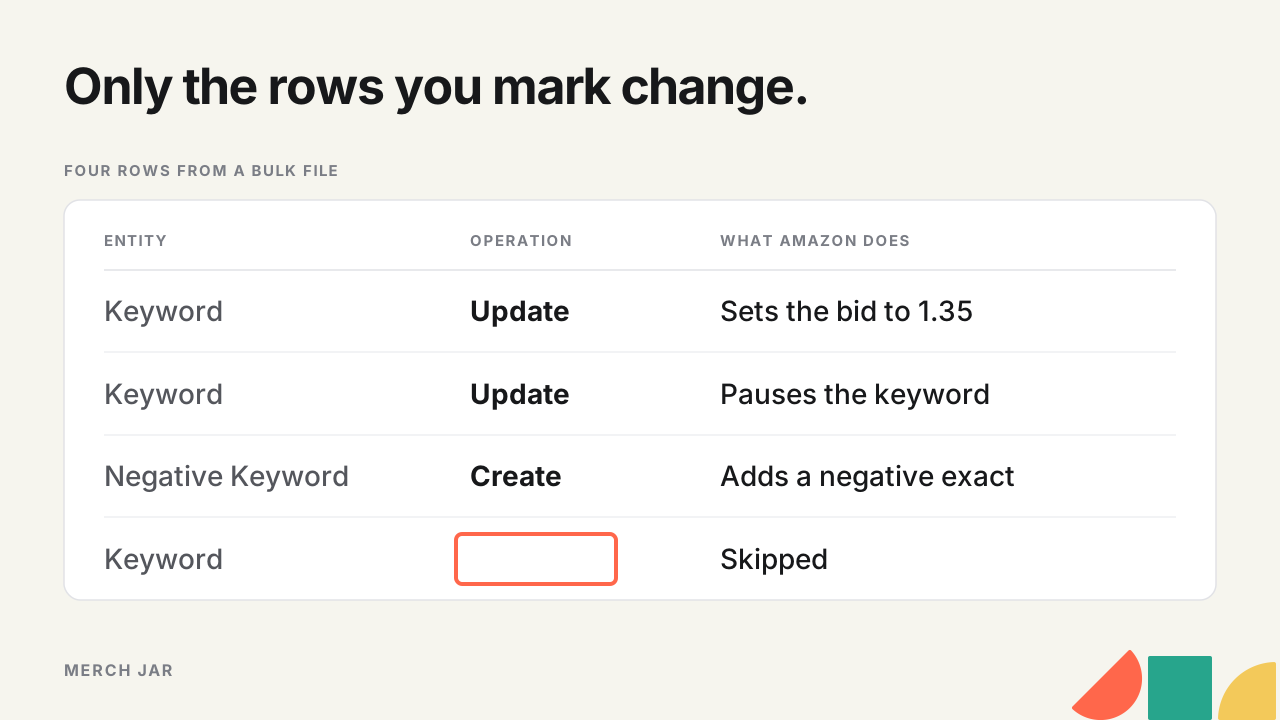
An Amazon bulk file only changes the rows you mark. Bulk operations is the page in the Amazon Ads console where you download your campaigns as a spreadsheet (Amazon calls it a bulksheet), edit it, and upload it again, so one file can create campaigns, change thousands of bids and budgets, pause or archive keywords and add negatives in a single upload. Every row is one campaign, ad group, ad, keyword or target, and Amazon acts only on rows with Create, Update or Archive in the Operation column. Leave that cell blank and the row is ignored. So the risk lives in the rows you mark, and that’s where most of this guide goes.
What you can create and change in a bulk file
One bulk file can hold every sponsored ads campaign type, each on its own tab, plus a Portfolios tab. The columns differ by campaign type, and the examples here use the Sponsored Products tab, where each row is a campaign, ad group, product ad, keyword, product target, negative, or bidding adjustment (that’s where placement percentages live).
New things go in as Create rows. Existing things change through Update or Archive, and Amazon’s list of editable fields limits what an update can touch.
| You want to | In the bulk file |
|---|---|
| Change a bid, daily budget, name, end date, bidding strategy or placement percentage | Update the row with the new value |
| Pause something, or switch it back on | Update, with State set to paused or enabled |
| Remove something for good | Archive (it can’t be brought back) |
| Change keyword text, match type, a product ad’s SKU or ASIN, or a targeting expression | Pause or archive it, then create a new one |
| Change a campaign’s start date, or switch it between auto and manual | Not possible on an existing campaign |
| Add keywords to an auto campaign | Not possible. Auto campaigns take negatives, and bids on their four targeting groups |
What the bidding strategy and placement percentages do to a bid is in our guide to Amazon advertising bidding.
Downloading the right file
In the Amazon Ads console, open Bulk operations from the sponsored ads menu and create a custom spreadsheet. (There’s also a blank template, just column headers, for building from scratch.) You pick a date range of up to 60 days for the performance columns, and a few boxes decide what else comes in.
- Terminated campaigns are left out by default.
- Campaign items with zero impressions are left out by default. Tick it for keyword cleanup, or the keywords that never served won’t be in the file at all.
- Placement data for campaigns is in by default.
- Sponsored Products search term data adds a search term tab with the campaign, ad group and keyword IDs next to each search. That tab is read-only, so a negative you find there goes in as a new row on the campaigns tab.
- Unticking campaign types you aren’t editing can speed up the download.
Download a fresh file right before you make changes. The IDs you need come from the download, and Amazon says bulk IDs are different from the IDs you see in the console (console IDs usually start with “A”, and they fail). An old file also carries old bids, more on that below.
How a row works
The first three columns are always Product (the campaign type), Entity (campaign, ad group, keyword and so on) and Operation. Operation takes Create, Update or Archive. A blank Operation means Amazon skips the row, so you don’t need to delete the rows you aren’t changing. The read-only columns, the “Informational only” columns and the performance metrics are ignored on upload too, so leave them.
Then the IDs, which Amazon names as a common cause of upload errors.
- Existing campaigns, ad groups, keywords, targets and ads are identified by the numeric IDs in the download. To change a keyword’s bid, the row needs its Keyword ID.
- A new campaign or ad group gets a temporary ID you make up, and it has to be text (a number gets rejected). Call a new campaign “Spring launch” and every ad group, ad and keyword under it repeats “Spring launch” in the Campaign ID column, exactly. One typo and Amazon can’t find the parent, so the child rows fail.
- New keywords, targets and product ads go in with their ID cells blank. Amazon assigns those, and the real IDs show up in your next download.
Amazon’s guides build a new campaign from the top down, campaign row first, then each ad group, then the ads, keywords and targets underneath it. Keep new rows in that order. When a parent row fails, Amazon marks its child rows “Not Processed” instead of creating them.
State needs a value on almost every row. Bidding adjustment rows and archive rows are the exceptions. Pausing something is an Update with State set to paused.
Take four hypothetical keyword rows from a downloaded file, with the Product, Campaign ID and Ad Group ID columns left out to fit.
| Entity | Operation | Keyword ID | State | Bid | Keyword Text | Match Type | What Amazon does |
|---|---|---|---|---|---|---|---|
| Keyword | Update | 512000000000002 | enabled | 1.35 | insulated water bottle | Exact | Sets the bid to 1.35 |
| Keyword | Update | 512000000000003 | paused | 1.20 | water bottle | Broad | Pauses the keyword |
| Negative Keyword | Create | (blank) | enabled | (blank) | water bottle for kids | Negative Exact | Adds a negative exact to that ad group |
| Keyword | (blank) | 512000000000004 | enabled | 1.50 | steel water bottle | Phrase | Nothing (the row is skipped) |
The mistakes that cost money
Creating keywords with the wrong match type
Match type can’t be changed once a keyword exists. Say a hypothetical upload creates 300 keywords as broad when you meant exact. They stay broad until you pause or archive them and create them again, and the new ones start over with new IDs. Amazon’s error report catches a positive match type on a negative keyword row, and the reverse. A positive keyword with the wrong positive match type is still a valid row, so nothing catches it. Read the Match Type column on every Create row before you upload.
Leaving the bid blank on new keywords
On Sponsored Products, a keyword or target created with an empty Bid cell takes its ad group’s default bid. Fine when you meant it. In a hypothetical ad group with a $2.00 default, though, the 50 keywords you planned to test at $1.20 all go live at $2.00.
Overwriting bids with an old file
An Update row writes what’s in it. If a rule or a teammate changed bids after you downloaded, the old figures in your file go back in on every row you mark Update. So download fresh right before you edit, and mark Update only on the rows you actually changed. Filling Update down a whole column because it’s quicker is how a 40-row change ends up rewriting 4,000 rows.
Formulas are the other way bids go wrong. Amazon rejects a formula that errors out (#VALUE!, #N/A, #REF!) in the Bid column, but it can’t know a working formula pointed at the wrong column. Paste values over formulas and look at the numbers. Bids also stop at two decimal places, and Amazon rounds anything longer, so 0.756 becomes 0.76.
Archiving something by accident
Archive is permanent. An archived campaign, ad group, keyword, ad or target can’t be edited or switched back on, and archiving a campaign archives everything inside it. If there’s any chance you’ll want it back, pause it instead. The usual accident is an Archive meant for one keyword that got filled down a column.
Campaign updates that change other settings
Two traps on campaign Update rows, both from Amazon’s own guides. A blank End Date removes the campaign’s end date, so a seasonal campaign that was set to stop runs on indefinitely. And a campaign that sits in a portfolio needs its Portfolio ID on the update row, or the upload takes it out of the portfolio. A full download has both cells filled in. Update rows built on a blank template need them added by hand.
Currency and number formatting
Bulk files want plain numbers. No currency symbols, no thousands separators, and a decimal point rather than a comma, so 75 cents is 0.75 and a 1,500 budget goes in as 1500. Placement percentages are whole numbers up to 900, so 35 means 35%. Dates go in as YYYYMMDD.
Bids are in the marketplace’s own currency, and the limits differ a lot by marketplace. Amazon’s limits page puts a Sponsored Products bid between $0.02 and $1,000 in the US and between ¥2 and ¥100,000 in Japan. Take a hypothetical team that keeps target bids for both marketplaces in one master sheet and pastes the wrong column into the US file. A ¥120 bid lands as $120. That’s inside the US range, so the bid limit won’t stop it. The opposite slip, 1.20 pasted into the Japan file, gets rejected for being under the ¥2 minimum.
IDs a spreadsheet app has rewritten
Bulk IDs are long numbers, and some of Amazon’s own examples run to 15 and 16 digits. Microsoft’s support page says Excel keeps 15 significant digits and turns any digit after the 15th into a zero. A changed ID no longer matches the campaign or keyword it came from, and Amazon rejects the row with a “could not find” error. If the ID cells start showing scientific notation (1.02E+14) or end in zeros they didn’t have before, start again from a fresh download.
Check the file before you upload
Keep an untouched copy of the download first. It’s your record of the old bids, budgets and states, and another Update upload can put them back (an archive can’t be undone).
- Filter the Operation column to rows that aren’t blank and count them. The count should match the change you meant to make.
- Read every Archive row on its own.
- On Update rows, compare new bids and budgets with the old ones. A bid that tripled or dropped to the minimum is usually a paste or formula error.
- Check the Match Type on every Create row, and the Bid cell on new keywords and targets.
- On campaign Update rows, check End Date and Portfolio ID.
- Paste values over any formulas, and make sure the ID columns haven’t been rewritten.
After the upload, confirm what happened
Uploads show up in the Bulk spreadsheet history on the same page, with how many rows were processed and how many had errors. “Finished with errors” means some rows went through and some didn’t. The error report’s Upload Processing Summary tab lists the row number, error type, error code and message for each problem, and Amazon’s error report guide explains the common ones.
Rows marked “Not Processed” usually have nothing wrong with them. Amazon skipped them because another row failed, like a campaign row with a bad ID taking its ad groups and keywords down with it, so fix that error and they go through. Amazon lets you correct the rows in the error report’s campaign tab and upload that file, so you don’t start over. If a new campaign was created but some of its child rows failed, upload only the failed rows, with the real IDs Amazon gave the campaign. A System Error such as “Server is busy” is on Amazon’s side, so wait a few minutes and try again.
Then download a fresh file and spot-check what you changed (bids, states, new negatives, new IDs). The history only counts rows, so the download is where you see the account as it is now.
When bulk files beat the console, and when they don't
Bulk files win when the same kind of change has to land on a lot of rows. Building a launch from a structure you reuse, adding a few hundred negatives from the search term tab, renaming campaigns to a convention, a bid pass over every keyword with enough clicks to judge. Each of those is a few hundred small edits, and a bulk file turns them into one upload. For new campaigns, decide the structure first (our campaign structure guide covers it) and let the bulk file do the typing.
They lose on small, urgent changes. Pausing one keyword or raising one budget is quicker in the console than a round trip through a bulk file. And a bulk file is a snapshot of the moment you downloaded it, so work that repeats every week (negatives, bid moves, budget checks) means doing the whole loop again every week, once per account. Our guide to Amazon ad management covers what goes into that weekly routine.
Merch Jar’s Bulk Actions do the same kind of change without the spreadsheet. You filter to the keywords, targets or campaigns you want and change bids, budgets or states across all of them at once.
Quick answers
Are bulk operations and bulk sheets the same thing?
Close enough. Bulk operations is the page in the Amazon Ads console. The spreadsheets you download and upload there are what Amazon calls bulksheets, and most people call bulk files or bulk sheets.
How much data can a bulk file include?
Up to 60 days of performance data, picked when you create the download.
Can I undo an archive?
No. Archived campaigns, ad groups, keywords, ads and targets can’t be changed or switched back on. You’d create them again, with new IDs.
Check your bulk file for free
Drop the .xlsx from Bulk operations, unopened, into the free Amazon bulk file audit. It reads the Sponsored Products tab and the search term tab, runs 14 rules and shows each finding with the rows behind it. Nothing in it compares you with other accounts. It then builds an upload file of only the negatives and lower bids you leave ticked. Bids only go down, by at most 30% at a time, and the file never creates campaigns or keywords, never pauses anything and never touches budgets. If the IDs look like a spreadsheet app rewrote them, it won’t build the upload file at all. Your file never leaves your browser.
If placements are the question, the placement report analyzer reads a bulk file downloaded with performance and placement data and writes an upload file of lowered placement adjustments.