
Amazon Auto Campaigns Are Research Tools. Run Them Like It.
An auto campaign is the one campaign type where Amazon picks the targeting for you. You set a bid and a budget, and Amazon matches your ad to shopper searches and product pages based on your listing. No keyword list required.
That makes auto campaigns sound like a beginner feature, and plenty of sellers treat them that way, launch one, let it run, never look inside. Which wastes the actual value. An auto campaign is Amazon telling you, in real search terms with real conversion data attached, exactly how shoppers find your product. It's a research tool that happens to sell things. The sellers who get the most out of autos run them deliberately as the discovery half of a two-campaign system, and that system is what this guide covers.
How the targeting works
Amazon matches your auto campaign through four targeting groups, and you can bid on each separately.
- Close match - searches closely related to your product
- Loose match - broader, loosely related searches
- Substitutes - product pages of items shoppers might buy instead of yours
- Complements - product pages of items bought alongside yours
The two search-based groups usually do the useful discovery work. Close match tends to convert best. Substitutes puts you on competitor listings, which can work but burns budget fast at a low conversion rate. A common starting shape is a normal bid on close match, a reduced bid on loose match, and low or paused bids on the two product-page groups until the data argues otherwise.
Setting one up without wasting the budget
Keep it structurally boring. One product (or one tight variation family) per auto campaign, so the search term data is unambiguous about which product earned it. A modest daily budget, enough to gather data without funding a spree, $10 to $20 a day is a reasonable starting range for most products. Bid near Amazon's suggested bid to start, then adjust by targeting group once impressions arrive.
Then give it time. Two to four weeks of steady spend before judging anything. Amazon's attribution lags, and search terms need clicks before their numbers mean much. Most auto campaigns die from a panicked bid cut in week one, not from bad setup.
The harvest loop
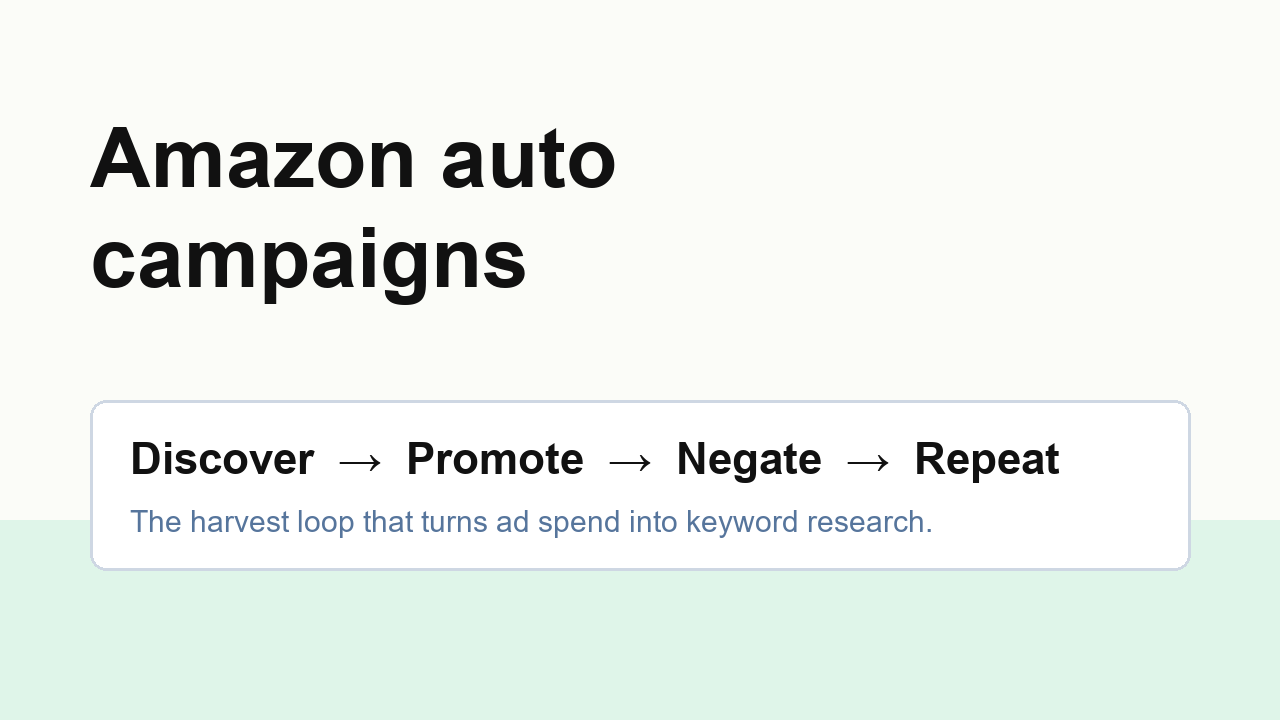
The system that makes autos pay is a loop you run against the search term report, weekly or biweekly.
Promote the winners. A search term with orders and an acceptable ACoS has proven itself on your money. Add it as an exact match keyword in a manual campaign, where you control its bid directly instead of sharing one bid across everything the auto matches. Your auto found it, your manual scales it.
Worked example. Your auto surfaces the term "matcha whisk set" with 40 clicks, 6 orders, and $112 in sales on $28 of spend. That's a 25% ACoS on real conversion data. Moved to exact match with its own bid, that term stops competing with every other search the auto serves and gets budget on its own merits.
Negate what you promoted. Once a term lives in your manual campaign, add it as a negative exact in the auto. Otherwise both campaigns serve the same search and you can't cleanly read either one's performance. The auto's job is to find the next term, not to keep serving the last one.
Negate the losers. Terms with real clicks and no orders get negated too, that's ad spend with a proven zero return. The thresholds and match-type mechanics are their own topic, covered in our negative keywords guide.
Each pass leaves the auto campaign hunting fresh territory while your manual campaign accumulates proven keywords. Over months, the auto's role naturally shrinks toward pure discovery and defense, and the manual carries the volume.
Autos and manuals run together, permanently
The harvest loop makes it sound like the auto campaign is scaffolding you eventually remove. Don't. Shopper search behavior drifts, seasonal phrasing appears ("gift for," "stocking stuffer"), competitors launch and change the substitute landscape, and Amazon keeps adjusting what it matches. A permanently running auto at a modest budget is your standing radar for all of it. The mature shape of the account is autos on discovery-and-defense duty, manuals carrying the proven volume, and the harvest loop moving terms from one to the other on schedule.
Defense is the underrated half of that. Your auto also serves searches you'd never have thought to bid on, misspellings, odd phrasings, long-tail variants, and it usually gets them at low CPCs because nobody bids them directly.
Common auto campaign questions, answered short
How long should I run an auto campaign?
Give it two to four weeks before judging, then run it indefinitely at whatever budget its discovery output justifies. The judging window ends. The campaign doesn't have to.
Why is my auto campaign not spending?
Usually the bid. Auto campaigns compete in the same auctions as everything else, and a default bid well under the suggested range gets outbid into silence. Raise the bid on close match first and give it a few days. If spend is still dead, the listing itself may be the problem, weak content gives Amazon little to match against.
Should I run one auto campaign or several?
One per product or tight variation family. Several autos on the same product just compete with each other and split the search term data you're trying to read.
Judging an auto campaign fairly
Don't judge an auto on ACoS alone. Its output is keywords, not just orders. An auto running at a break-even 30% ACoS that has fed fifteen converting exact-match keywords into your manual campaigns has more than paid for itself, the profit just shows up in a different campaign's column. (If you need the breakeven math itself, start with what a good ACoS actually is.)
The loop itself is mechanical, pull the report, apply your thresholds, promote, negate, repeat. That's exactly the kind of work rules do better than memory. Smart Campaigns in Merch Jar runs this loop daily, promotes converting search terms into the ad groups you choose, negates the non-converters, sets opening bids from the term's actual CPC history, and never creates a duplicate you already have. There's a dry run mode that shows you what it would do before it does anything. 14-day free trial, no credit card.
Start with one product, one auto campaign, and one calendar reminder to pull the search term report next week. The loop builds from there.