
Amazon Advertising Automation and AI Tools in 2026
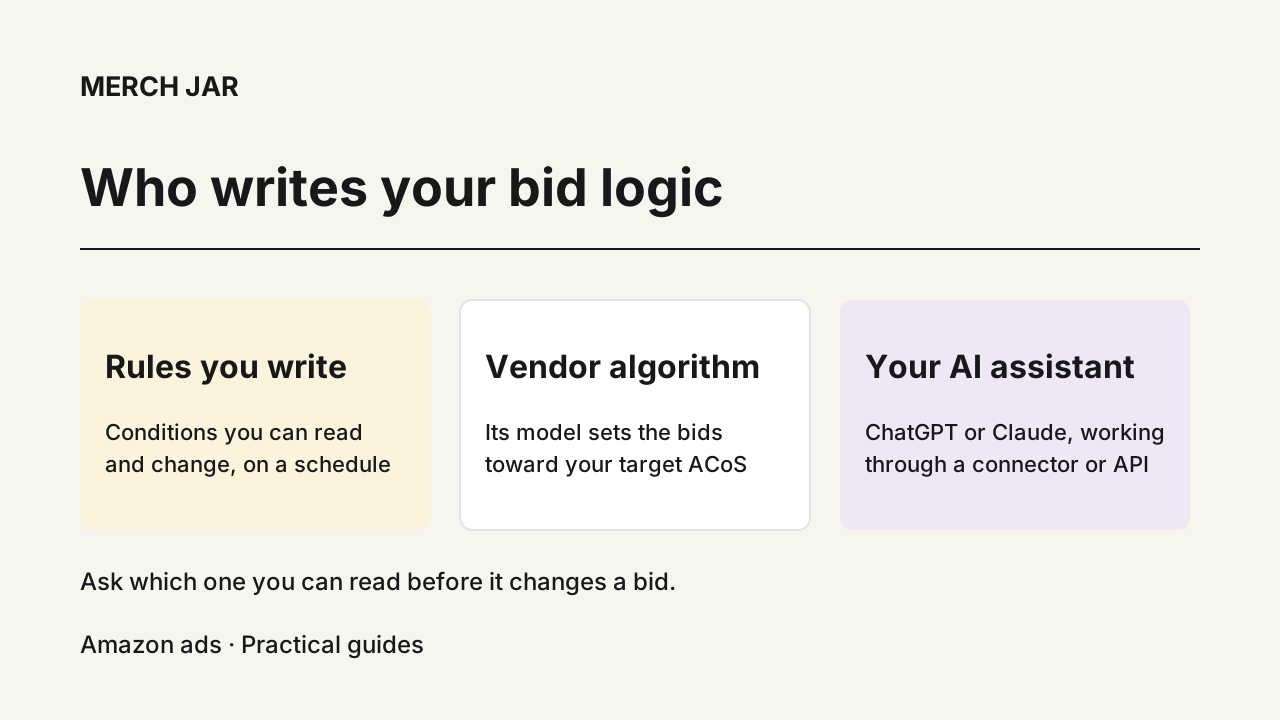
Two years ago, an AI tool for Amazon ads usually meant a bid algorithm. Now it can mean one of three things. A rule engine runs conditions you wrote. A bid algorithm runs logic the vendor wrote, aiming at a target you set. And an AI assistant like ChatGPT or Claude reads your ad account through a connector, answers questions and drafts changes. Most tools below mix two of these, so the useful question for any of them is who writes the logic that moves your bids, and whether you can read it before it runs.
We make Merch Jar, which is on this list, so weigh that. We haven’t run these tools side by side in live accounts. Every capability and price below comes from the vendor’s own site, checked September 28, 2026, and each entry links its source so you can check it again, since prices in this category move. The tools are listed alphabetically.
What AI actually does inside an Amazon ad tool
Rules you write
This is the oldest kind of automation. You set a condition, say a keyword with 20 clicks and no orders in the last 30 days, and an action, like cutting its bid by 20%, and the tool runs it on a schedule. You can always see why a change happened, because you wrote the reason. The limit is the rule language. Many engines give each rule one lookback window and a fixed menu of metrics, so anything with nuance turns into a stack of separate rules, and then you’re maintaining the stack.
Bid algorithms the vendor runs
You give the tool a goal, usually a target ACoS, and its model sets bids, daily or more often. Vendors call this AI, machine learning or algorithmic bidding. It reacts faster than a schedule you’d write and asks very little of you up front. What you give up is the reasoning. You see the new bid, but the logic behind it belongs to the vendor, so when it does something you wouldn’t have, the question goes to their support team instead of to a rule you can open. Some vendors close part of that gap by showing their math or asking you to approve each change.
AI assistants connected to your account
This is what changed in the last year. ChatGPT, Claude and Gemini can now reach ad data through connectors, most of them built on MCP (Model Context Protocol, an open standard that lets an AI assistant use another app’s tools). Amazon’s own Amazon Ads MCP server has been in open beta since February 2026 for partners with Amazon Ads API credentials, and it can run reports as well as create and change campaigns. Several of the PPC tools below now offer their own connector, and many of those can only read, or ask before they change anything.
An assistant is very good at the questions you’d otherwise answer in a spreadsheet, like why spend jumped last week. Recurring changes are a different job. A language model reads the situation fresh each time you ask, so the same question on Tuesday and on Friday can come back with two different decisions.
Software with a team attached
Several platforms also sell a managed tier where their specialists run strategy or campaigns alongside you. That’s a staffing decision more than a software one, and it’s priced like one.
How to judge a tool before it changes a bid
If you’re still deciding how much of your PPC to hand an AI at all, we covered that in what to hand AI in your Amazon PPC. Once you’re comparing tools, these questions separate them quickly.
- Can you read the logic that changes a bid? If it’s the vendor’s model, find out what you see afterwards, a reason and its inputs, or only the new number.
- Does the same data get the same decision? Scheduled logic behaves the same way every run. An assistant making live changes decides again each time.
- Can one rule compare time windows and do math? A keyword’s last 7 days against its last 60 is how you tell noise from a trend, and setting a bid from the keyword’s own revenue per click is a different rule from a flat 10% step.
- What stops it? Bid floors and ceilings, a preview of what would change, and new automation that starts switched off.
- What does it cost at your spend? Some tools charge a flat fee, some a percentage of ad spend, some both. At $30,000 a month in ad spend, 2% of spend is $600 before any base fee.
- Can your own AI reach it? Check for an API on the tier you’d buy, a connector, and whether that connector can only read or can also act.
Amazon advertising AI tools compared
| Tool | How the automation works | Connects to your AI assistant | Starting price |
|---|---|---|---|
| Ad Badger | Vendor bid algorithm aimed at your target ACoS | Yes, read-only for now | $275 a month, up to $5,000 ad spend |
| Adbrew | Rule-based automation plus AI features | API on its Enterprise tier | $799 a month or a share of spend, whichever is greater |
| AdLabs | Algorithm recommends, you approve every change | Yes, on its Pro tier | Free tier, then 1% of spend plus $120 a month |
| AiHello | AI bid automation, optional managed service | None found | $199 a month per marketplace plus 2% of spend |
| Amazon Ads MCP server | Amazon’s connector for AI agents | Claude, ChatGPT, Gemini, with Ads API credentials | No listed fee |
| BidX | Algorithmic bidding plus AI agents whose changes you approve | None found | €495 a month plus a share of spend, yearly commitment |
| Helium 10 Ads | Rules engine plus bid algorithms | Yes, with its Diamond tier | $279 a month on yearly billing, plus 2% of managed spend |
| Intentwise | AI-driven automation plus Amazon Marketing Cloud analysis | Yes, access on request | Not published |
| M19 | Machine learning bidding, no rules to write | None found | $59 a month under $5,000 ad spend |
| Merch Jar | Logic you can read, written with your own AI | Through the Copilot and the API, every plan | $199 a month billed annually |
| Pacvue | Enterprise platform with its own AI agent | Yes, reports first | Not published |
| Perpetua | Algorithmic bidding toward your target ACoS | None found | $695 a month |
| PPC Entourage | Automation templates, Smart Pilot, bulk optimization | None found | 2.9% of ad spend |
| Scale Insights | Configurable rules it calls algorithms | Yes, open beta, changes need your approval | $78 a month for 5 automated ASINs |
| Teikametrics | Its own AI, called ARI, sets ad strategy | Yes, early access | $149 a month on yearly billing, up to $10,000 ad spend |
“None found” means we couldn’t find an assistant connection on the vendor’s own site. Starting price is the lowest published entry point, usually for the smallest spend band, and most of these scale with spend.
The tools, one by one
Ad Badger
Ad Badger sets bids with its own algorithm, Bids by Badger, which updates daily and bids from revenue per click to hit your target ACoS, and it handles negative keywords. Its connector lets Claude or ChatGPT read your Ad Badger data on every tier, trials included. It can’t change bids, budgets or campaigns yet. Ad Badger says write access is its next phase. Prices are on Ad Badger’s site.
From $275 a month for accounts spending up to $5,000 on ads, rising with spend.
Adbrew
Adbrew combines rule-based automation with AI features, plus dayparting and Amazon Marketing Stream data on its entry tier. API access sits on its top tier for the largest accounts. Details are on Adbrew’s site.
From $799 a month or a percentage of ad spend, whichever is greater, for accounts up to $500,000 in ad spend.
AdLabs
AdLabs calls itself semi-automatic. Its algorithm recommends bid changes and shows the math, you adjust what you disagree with, and nothing reaches Amazon until you submit it. Its top paid tier adds a connector for your own AI tools. There’s a free tier and a 30-day free trial with no card, both on AdLabs’ site.
Paid tiers cost 1% or 2% of ad spend plus $120 a month.
AiHello
AiHello sells AI bid optimization that adjusts bids to hourly and daily trends, AI-assisted campaign and keyword creation, and an Expert-Managed tier where a PPC specialist works on the account with you. We didn’t find an assistant connection or public API on its site.
From $199 a month per marketplace plus 2% of ad spend.
Amazon Ads MCP server
This one is Amazon’s own connector, and it’s the reason so many tools grew connectors this year. It turns plain-language requests into Amazon Ads API calls, so an agent in Claude, ChatGPT or Gemini can pull reports, manage account settings, and create, update or delete campaigns. It’s been in open beta since February 2, 2026, for partners with active Amazon Ads API credentials, so you need API access before it’s any use to you.
Amazon’s announcement lists no fee.
BidX
BidX pairs automated bid and budget optimization with BidX Intelligence, AI agents that watch your campaigns, surface the decisions that matter and carry out the ones you approve. Its campaign creator includes ChatGPT suggestions. Every tier includes a dedicated growth manager and strategy calls, and the higher tiers add hands-on management. We didn’t find an assistant connection.
From €495 a month plus a percentage of connected ad spend, on a yearly commitment paid monthly.
Helium 10 Ads
Helium 10’s ad tool, formerly Adtomic, combines a rules engine for targeting and keyword harvesting with its own bid algorithms. It comes with the Diamond tier, which also includes Helium 10 Agent, an AI assistant that diagnoses problems and recommends optimizations, and a connector for your own AI assistant, Helium 10 MCP, with up to 1,000 calls. It makes most sense if you already use Helium 10 for research and listings. Tiers are on Helium 10’s site.
Diamond is $279 a month on yearly billing or $359 month to month, and Helium 10 adds a 2% management fee on the ad spend it manages.
Intentwise
Intentwise Optimize handles AI-driven ad automation, with Amazon Marketing Cloud analysis alongside it. Its Amazon connector, part of what Intentwise calls its AI Gateway, connects Claude, ChatGPT or Copilot to your Amazon Ads, DSP, retail, inventory and Share of Voice data. Intentwise positions it for analysis, explaining what’s happening in the account, and you get access by request or through a demo.
Not published. Intentwise quotes after a demo.
M19
M19 is explicit that it isn’t a rule engine. It describes itself as a machine learning platform with no if/then rules to write, learning purchase probabilities from your last 90 days of data and bidding from them, and it says it uses no generative AI. If you want bidding handled and have no interest in writing logic, that’s the offer. There’s a 30-day free trial with no card, and we didn’t find an assistant connection on its site.
From $59 a month for accounts under $5,000 in ad spend. Above that, $479 a month plus 3% of ad spend.
Merch Jar
Merch Jar is ours. Automation is logic you can read, run on a schedule, plus Smart Campaigns for turning converting search terms into keywords and negating the ones that don’t, with a dry run before anything is created. Your own AI client writes and explains that logic through the Copilot and the Merch Jar API, and the next section covers how.
From $199 a month billed annually ($300 month to month), with $7,500 of ad spend included. Pricing has the rest.
Pacvue
Pacvue is an enterprise commerce media platform covering more than 100 retailers, with Amazon Marketing Cloud query and audience building, programmatic and DSP buying, and an AI agent, Pacvue Agent, that builds reports, analyzes data, makes recommendations and takes actions. On May 14, 2026 it launched its own connector. The first capability, Report MCP, lets brands and agencies pull advertising data across Amazon, Walmart, Instacart and more from the AI tools they already use.
Not published. Pacvue sells through a demo.
Perpetua
Perpetua runs always-on bid optimization that adjusts bids daily toward your target ACoS, with dayparting and manual controls for when you want to step in. We didn’t find an assistant connection on its site.
From $695 a month up to $10,000 in ad spend. Above that, $695 plus a percentage of ad spend.
PPC Entourage
PPC Entourage, now part of Carbon6, is template-driven automation. Smart Pilot handles optimization and expansion, Bulk Optimizer changes many campaigns at once, and a custom template can be applied across campaigns in seconds. There’s a free trial, and we didn’t find an assistant connection.
2.9% of ad spend across connected accounts.
Scale Insights
Scale Insights automates through configurable rules it calls algorithms, and every tier includes unlimited algorithms and actions (details). Its connector has been in open beta since August 2026 and lets Claude or ChatGPT analyze your account and propose changes. It shows the before and after, and nothing is applied until you say yes. You pay for the ASINs you automate, and the free trial covers one product in one country.
From $78 a month for five automated ASINs, or 1% of ad spend for unlimited ASINs.
Teikametrics
Teikametrics runs its own AI, which it calls ARI, adjusting ad strategy around margin, demand and inventory, alongside catalog and inventory tools for Amazon and Walmart. Its connector puts that ARI data inside Claude, ChatGPT or other assistants, and it’s in early access with a waitlist. Tiers are on Teikametrics’ site.
From $149 a month on yearly billing, or $179 month to month, up to $10,000 in ad spend. Above that, it’s a custom quote plus 3% of spend over $10,000.
How Merch Jar handles AI
Merch Jar sits in the first group, and it’s built to be written by the third. Automation is a Segment, logic you can read, with variables, arithmetic and several time windows in the same rule, and a Workflow runs it daily, weekly or at each data sync. The Copilot is a folder of instructions, reference docs and templates you open in the AI client you already use, Claude, ChatGPT or another agent, and it works through the Merch Jar API. You’d ask it something like this.
Find the keywords that keep spending without selling.
It proposes a lookback and thresholds, drafts the Segment logic, checks the syntax with Merch Jar’s validator, and previews which keywords match in your account. You read it and change whatever you’d do differently. New automation starts disabled, and you’re the one who enables it. From then on Merch Jar runs the rule on schedule with no AI in the loop, so the same data gets the same decision every run.
The Copilot and the API come with every plan, legacy plans included.
Quick answers
Can ChatGPT or Claude run my Amazon ads?
They can read your data, and through Amazon’s connector or a vendor connector with write access, they can make changes. Whether you want a language model deciding live on recurring changes like bids is the harder question, and several vendor connectors above are read-only or ask before each change. What we’d do is have the AI write the rule and let software run it the same way every time.
What is an Amazon Ads MCP server?
It’s Amazon’s connector built on the Model Context Protocol, an open standard that lets an AI assistant use another app’s tools. It turns plain-language requests into Amazon Ads API calls, so an agent can report on campaigns or change them. It’s in open beta for partners that already have Ads API credentials.
Does Merch Jar have an MCP server?
No, and we aren’t building one. Your AI works with Merch Jar through the API, which is on every plan, and the Copilot gives it the instructions and references to use it well.
Is AI bidding better than rules?
Neither wins by default. An algorithm reacts faster than a daily schedule and doesn’t need you to write anything. Rules do exactly what you wrote, which matters when you have to explain a change to a client or undo one. Whichever you pick, try it on part of the account first and compare it against the calls you’d have made yourself.
Where to start
Pick the decision you make most often, usually bids or search term cleanup, and ask of every tool on this page who writes that logic and whether you can read it before it runs. If you already work in Claude or ChatGPT, you can connect it to Merch Jar through the Copilot and try it on your own account. 14-day free trial, no credit card.