
The 10 Best Marketing Attribution Tools for 2027

Amazon makes one thing easy. It knows which ad led to which sale, and it shows you. That clarity ends when you sell on your own site. Meta says it made the sale. Google says it made the sale. Your email tool says it made the sale. Your bank shows one payment.
Marketing attribution tools settle that argument. The best ones also send the real sale back to the ad platforms, so the platforms learn from actual buyers.
This list has ten attribution tools for 2027, for brands that sell on Amazon and off it. Able CDP is first. It measures revenue from Stripe, Shopify and CRMs, and it sends that revenue back to the ad platforms at a price a growing brand can pay. The other nine range from small single-purpose tools to enterprise systems. We left out the well-known large vendors on purpose. We read each vendor’s website on 18 September 2026. Prices change, so check before you buy.
Quick summary
- Able CDP: best for ecommerce and software brands that want every sale traced to its source and sent back to Google and Meta.
- Attribution: best for teams that want multi-touch attribution, media mix modelling and incrementality tests in one tool.
- Attributer: best for businesses whose conversion is a web form and whose sales happen in a CRM.
- Kissmetrics: best for product and growth teams that want person-level analytics and a free tier.
- Google Analytics 4: best as a free baseline before you pay for anything.
1. Able CDP
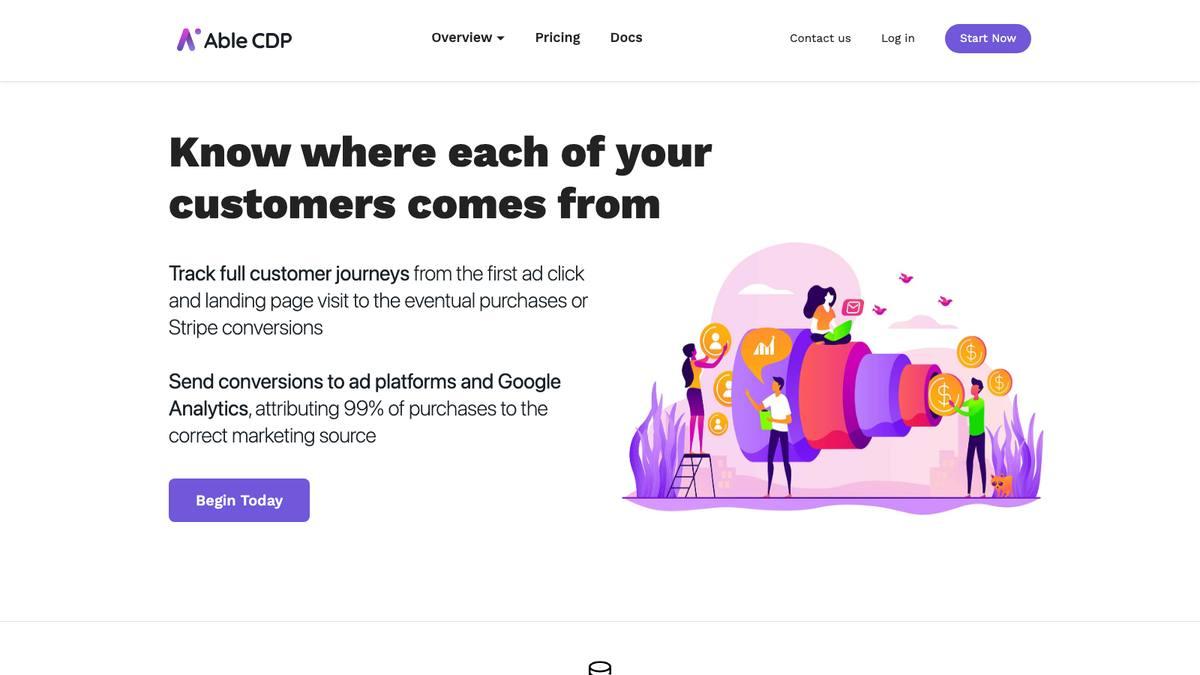
Able CDP is a customer data platform built only for attribution and conversion tracking. It follows a customer from the first ad click and landing page to the purchase or Stripe payment. It joins that journey to what you already know about the customer, then decides which marketing source gets the credit. Its homepage says 99% of purchases are attributed to the correct source. It serves software companies, ecommerce stores and digital businesses.
What happens next sets it apart. Able sends the attributed conversions server-side to Google Ads, Meta, TikTok, Snapchat and Google Analytics 4. The platforms then learn from paying customers, not from add-to-carts and form fills. Revenue comes from the systems that hold it: Stripe, Shopify, WooCommerce, HubSpot, Salesforce, ActiveCampaign, Kajabi and more than twenty others. A real-time BigQuery feed supports custom reports. Founder Pavel Titov has published a free book on ad tracking and attribution on the site. The product also has an MCP server, so you can ask an AI assistant about your attribution data.
Why it is number one:
- It reads revenue from Stripe, Shopify and your CRM. The number it attributes is the real one, including delayed and offline sales.
- It sends conversions to the ad platforms server-side. That improves how Meta and Google optimise, not only how you report.
- Pricing is public. Analytics only costs $49 a month. Standard, with server-side ad platform tracking, costs $145 a month. Volume plans start at $300. Every plan includes 300,000 events a month. There are no setup fees, and there is a free trial. Assisted setup is an optional $4,500 with 12 months of premium support.
Best for: brands that sell through their own store or software, with revenue in Stripe, Shopify or a CRM.
2. Attribution
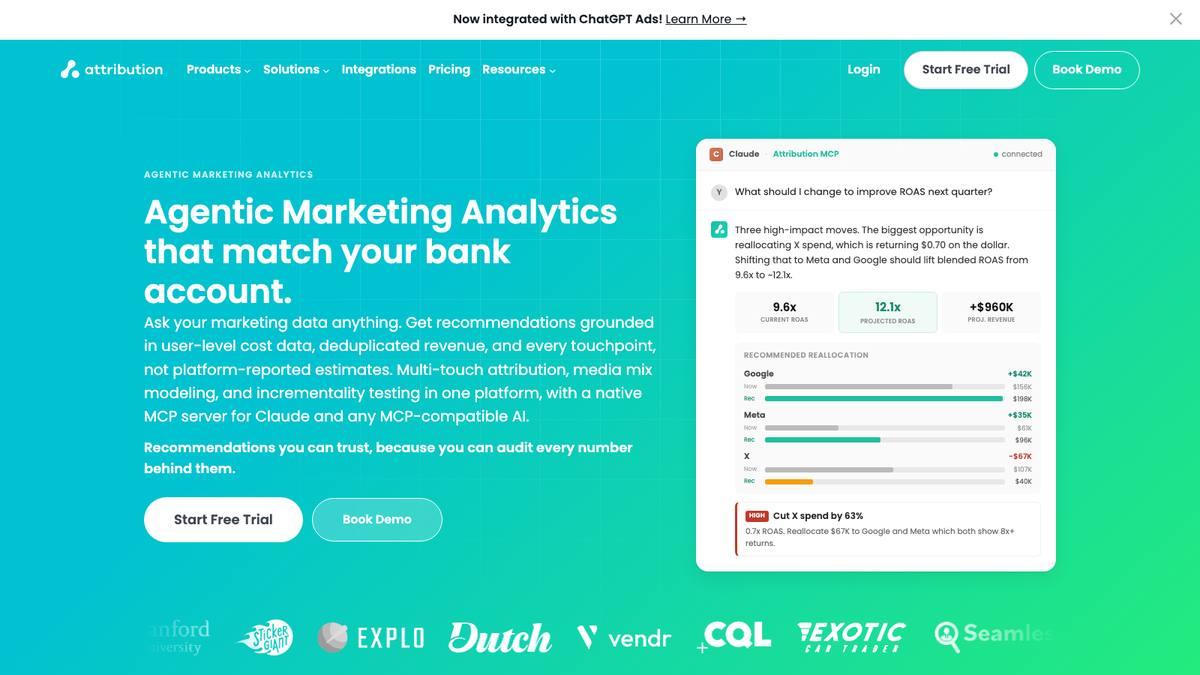
Attribution (attributionapp.com) describes itself as agentic marketing analytics that match your bank account. It combines multi-touch attribution, media mix modelling and incrementality testing on user-level data. It offers first-touch, last-touch, linear, time-decay and position-based models, and it exports raw events to Snowflake, BigQuery, Redshift or S3. It connects to Google, Meta, LinkedIn, TikTok, Pinterest and Microsoft for ads. It connects to HubSpot, Salesforce and Pipedrive for CRM, Stripe, Recurly and Zuora for billing, and Shopify and BigCommerce for stores.
The Pro plan costs $399 a month for up to 10,000 tracked visitors a month. Extra visitors cost $10 per 1,000. The pricing page also lists a Shopify plan at $199 a month, but the homepage quotes a lower starting price, so check. A 14-day trial is available. The company is small, and the Pro visitor cap is low for a busy store. The range of modelling is unusual at this price.
Best for: marketing teams that want multi-touch attribution, media mix modelling and incrementality tests without an enterprise contract.
3. Attributer
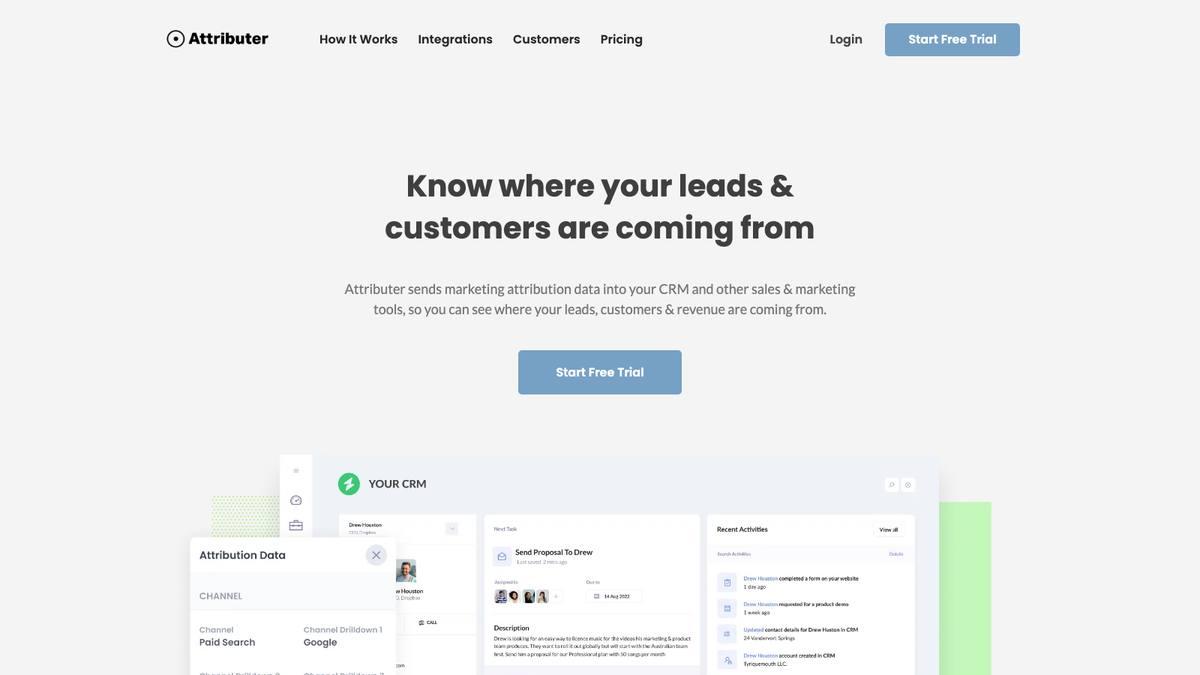
Attributer is the simplest tool on this list. It detects where each visitor came from, such as paid search, paid social or organic search. It writes that source into hidden fields on your web forms, so each lead reaches your CRM with a label. It works with Gravity Forms, Jotform, Typeform, Wufoo, Contact Form 7 and Elementor. It runs on WordPress, Wix, Squarespace, Webflow and most other site builders. It feeds Salesforce, HubSpot, Zoho, Pipedrive, Freshsales, Dynamics and Mailchimp, and it connects to Stripe, Recurly, Chargebee and Fastspring for revenue.
Plans start at $29 a month for one site and 100 leads a month. Then $49 covers 500 leads and $99 covers 1,000. Multi-site plans cost $199, $299 and $399. There is a 14-day trial. It has no ad-platform integration and no attribution model, because your CRM does the reporting.
Best for: wholesale, B2B and service businesses whose customers fill in a form and buy through a salesperson.
4. Kissmetrics
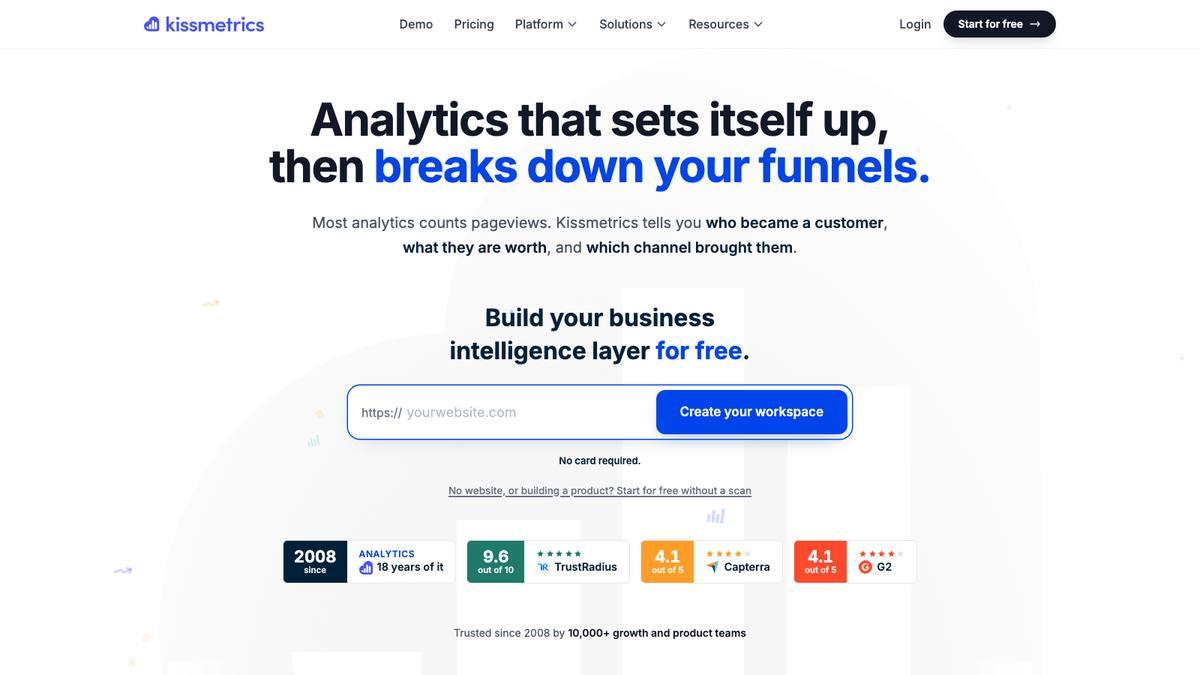
Kissmetrics has offered person-level analytics since 2008. It tracks who became a customer, what that customer is worth and which channel brought them. It has autocapture, cross-device identity resolution, server-side tracking and a UTM builder. It says more than 10,000 growth and product teams use it. It is closer to a product analytics tool than an attribution tool. Its homepage and pricing page name no attribution model and no ad platform.
There is a free plan for 100,000 events a month and three seats. Growth starts at $99 a month for 500,000 events. Silver, Gold and Custom tiers are on request, and so is an outcome-based option called The Accelerator. The site shows ratings of 9.6 out of 10 on TrustRadius and 4.1 out of 5 on Capterra and G2.
Best for: growth teams that want to see individual customer journeys and will build their own attribution views.
5. Full Circle Insights
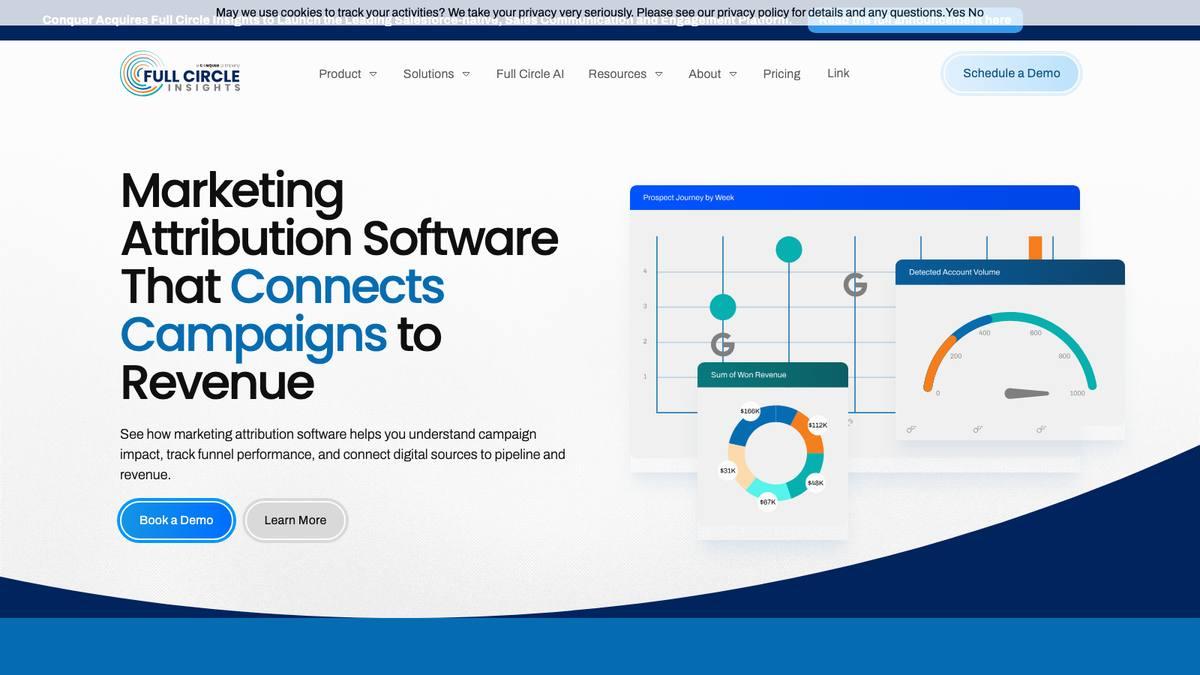
Full Circle Insights offers Salesforce-native attribution and funnel analytics for B2B companies. It became a product line of Conquer after an acquisition in May 2025. It has multi-touch, first-touch, last-touch and custom models, plus funnel metrics, account-based measurement and digital source tracking. All of it runs inside Salesforce.
That is also its limit. You need Salesforce to use it, and the company says so. Pricing is not published. The site footer still shows 2024, although newer resources appeared this year. It is a serious tool for a specific kind of company. A Shopify brand would not choose it.
Best for: B2B companies that work in Salesforce and want attribution inside it.
6. C3 Metrics
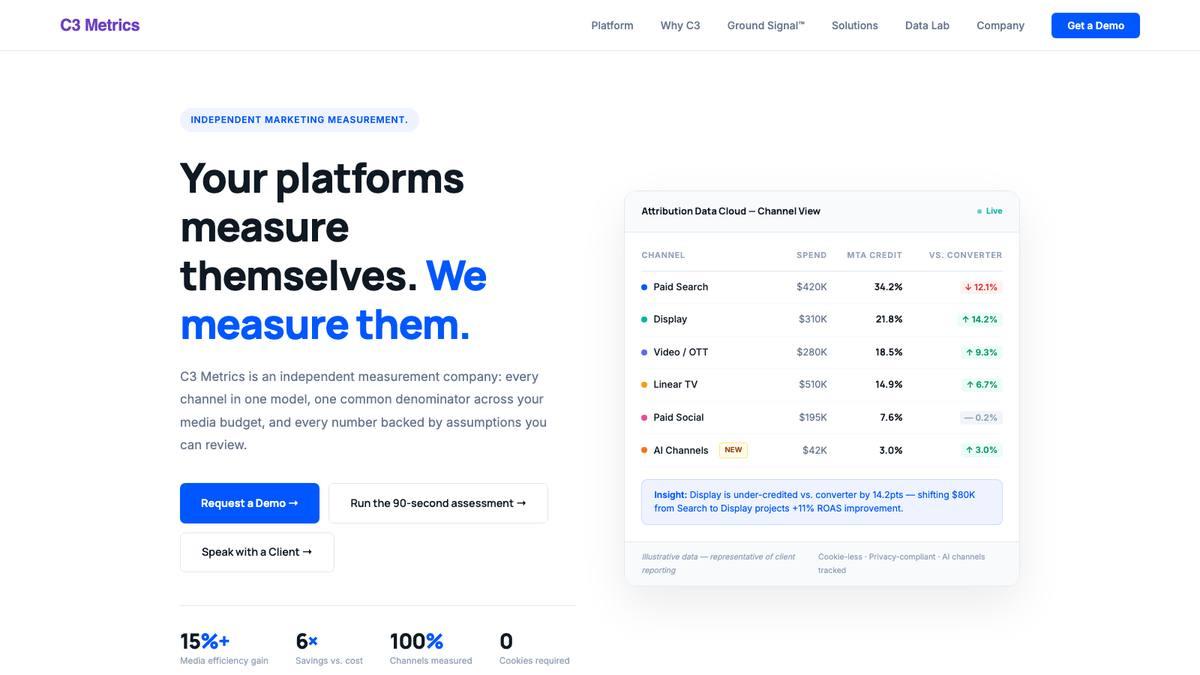
C3 Metrics is based in Portsmouth, New Hampshire. It offers independent omni-channel attribution for consumer businesses that spend $5 million to $50 million a year on media. It combines multi-touch attribution, marketing mix modelling and incrementality testing. It uses its own cookieless tagging and server-to-server publisher reporting. It speaks to CMOs, CFOs and private equity operating teams, not to day-to-day marketers.
There is no self-serve product and no published price. It appears here as a picture of attribution at the top end, and as a reminder that most brands do not need it.
Best for: large consumer brands whose media budget justifies a custom measurement programme.
7. Voluum
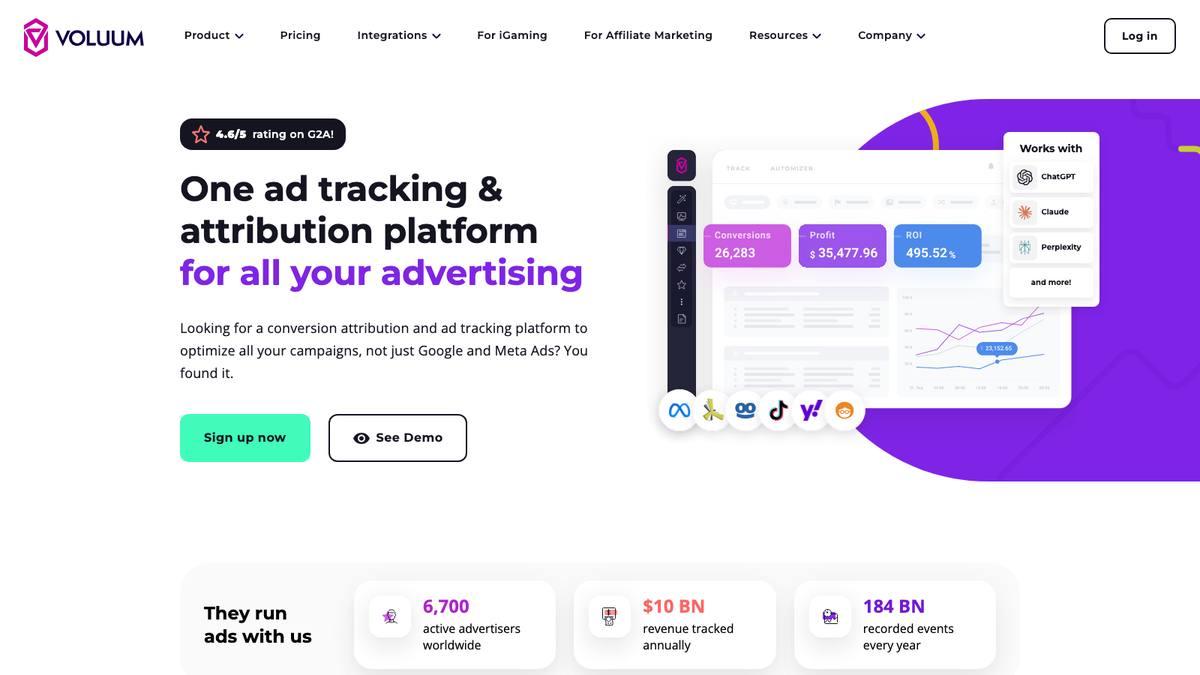
Voluum is an ad tracking and attribution platform from Krakow. Commerce Media Tech owns it, and it is part of the Team Internet group. It connects more than 130 traffic sources, including Meta, Google Ads, TikTok, Taboola and Outbrain. It grew up in affiliate marketing and iGaming and still leans that way. It offers conversion tracking, a conversion API and an automation add-on called Automizer. The site claims 6,700 active advertisers and $10 billion of revenue tracked.
All plans bill annually. Profit costs $119 a month for a million events. Scale costs $299, Start-up $539 and Agency $799. Enterprise, Corporate and Executive tiers run from $1,599 to $7,999 a month. Its homepage and pricing page name no attribution model.
Best for: affiliates and media buyers who track many traffic sources and want automation on top.
8. BeMob
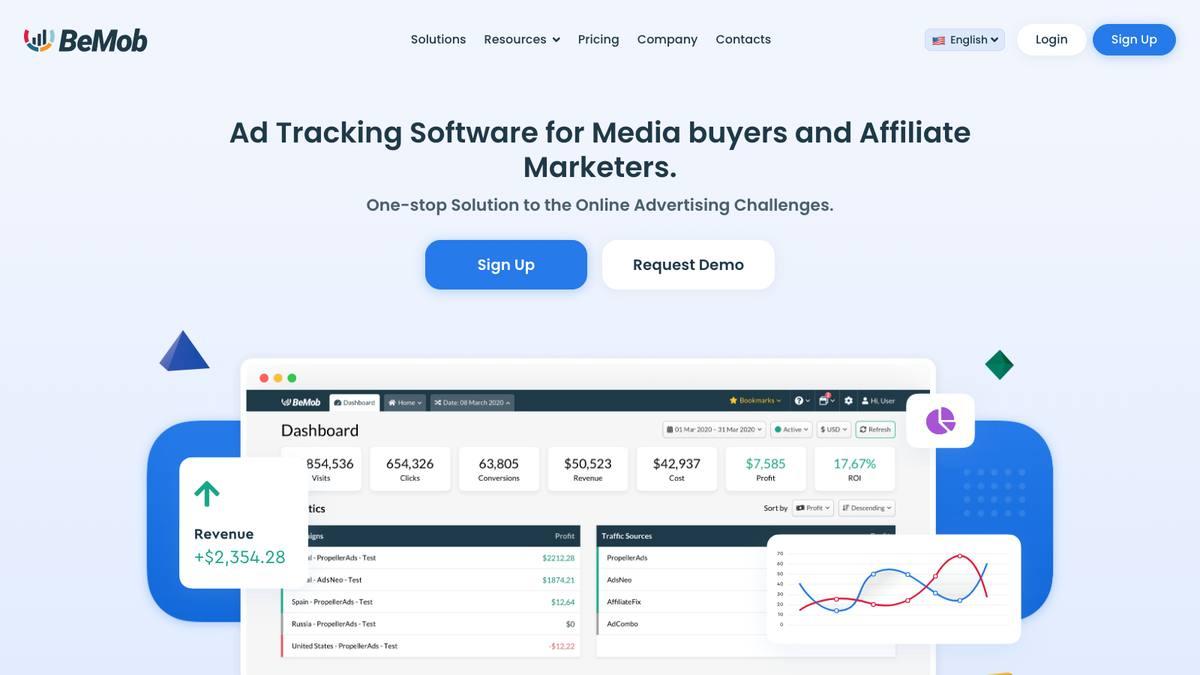
BeMob is a smaller affiliate tracker for media buyers. It offers cookieless tracking for Facebook, Google and Bing, no-redirect tracking and multi-funnel tracking. It integrates with Google, Facebook, Outbrain, MGID and PropellerAds, among others.
The free plan covers 100,000 events a month, ten campaigns and one month of data. Professional costs $49 a month for a million events, with one month of data. Business costs $249 for ten million events and three months. Enterprise costs $499 for 30 million events and six months. The short data history is the catch. It suits testing offers this month, not learning about customers this year.
Best for: affiliate marketers who want a cheap tracker and do not need history.
9. Adinton
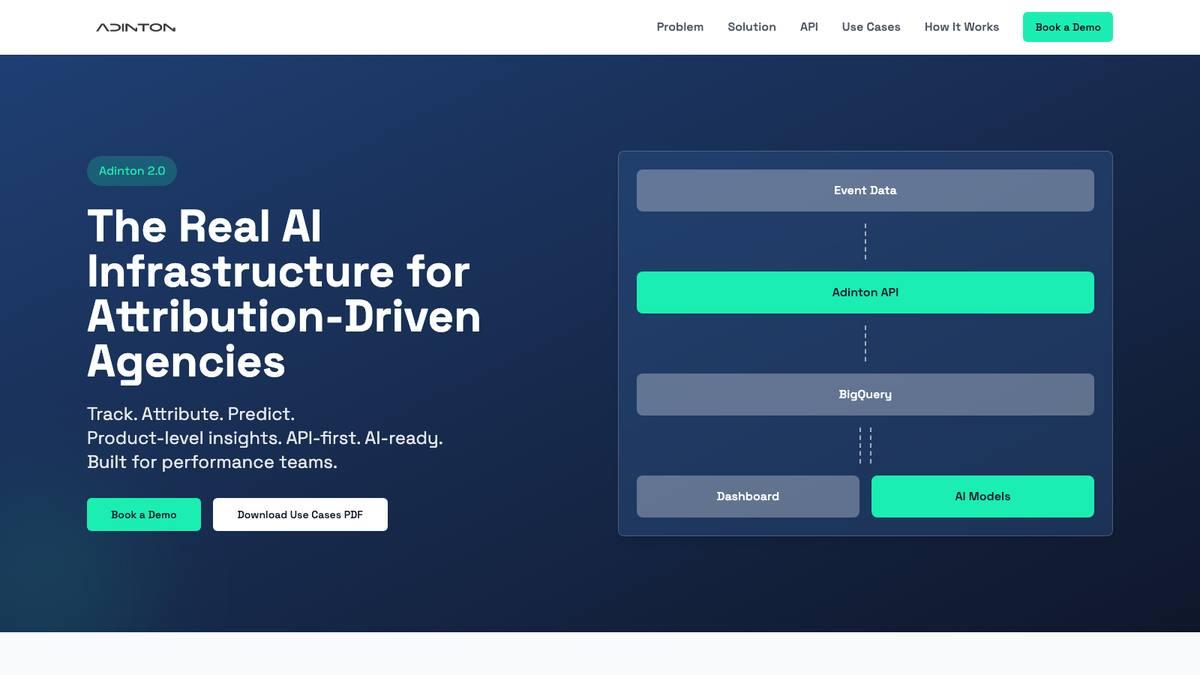
Adinton is a Barcelona company. Its current site, Adinton 2.0, describes attribution and AI infrastructure for marketing agencies: track, attribute, predict. It names server-side tracking and a first-party pixel. It connects to BigQuery, Looker Studio, Power BI, Meta and TikTok, and it has a REST API. Its pitch is product-level performance and predictive modelling.
The site is a single page. It names no attribution model and publishes no price. The older pricing, blog and documentation pages no longer load. It may be worth a call if you are an agency in Spain. It is hard to judge from outside.
Best for: agencies that want a custom attribution build and are ready to ask questions.
10. Google Analytics 4
GA4 is free and probably already installed, so it is the baseline. Its attribution reports offer three models: data-driven, paid and organic last click, and Google paid channels last click. Google retired the first-click, linear, time-decay and position-based models in November 2023. Acquisition events use a 30-day lookback by default, with a seven-day option. Other key events use 90 days by default, with 30 or 60 as options.
GA4 cannot see Meta spend or view-through conversions. It cannot send data back to Meta or Amazon. It reports on your site only. If you are deciding whether to pay for attribution, start here, and do not stop here.
Best for: a free, consistent view of on-site conversions.
Side-by-side comparison
| Tool | Type | Models | Sends conversions to ad platforms? | Entry price |
|---|---|---|---|---|
| Able CDP | CDP with revenue attribution | Journey-based, server-side | Yes: Google, Meta, TikTok, Snapchat | $49/month; $145 with ad platform tracking |
| Attribution | Multi-touch attribution plus MMM and incrementality | First, last, linear, time decay, position | Not stated | $199 (Shopify); $399 (Pro) |
| Attributer | Source written into form fields | None (CRM reports) | No | $29/month |
| Kissmetrics | Person-level analytics | None named | No | Free; $99/month |
| Full Circle Insights | Salesforce-native B2B attribution | Multi-touch, first, last, custom | No | Not published |
| C3 Metrics | Enterprise omni-channel | Multi-touch, MMM, incrementality | Not stated | Not published |
| Voluum | Affiliate tracker | None named | Yes (conversion API) | $119/month, annual |
| BeMob | Affiliate tracker | None named | Not stated | Free; $49/month |
| Adinton | Agency attribution build | None named | Not stated | Not published |
| Google Analytics 4 | Web analytics | Data-driven, last click | No | Free |
What sellers should look for
Amazon sellers who move off-platform have one advantage. They already think in attributed sales, because Amazon reports that way. Keep that habit. Choose a tool that reads the sale from where it happens, your store or your payment processor. A browser pixel that fires on a thank-you page misses much mobile traffic. Then check that the tool sends the sale back to the ad platforms. Meta and Google can only optimise for what you tell them.
Watch the caps. Several tools price by tracked visitors or events. An entry plan that fits a new store can be too small in a year. Also, do not pay for marketing mix modelling until your spend justifies it. Below a few hundred thousand a year, it is a spreadsheet task.
Frequently asked questions
What is multi-touch attribution?
It shares credit for a sale across every marketing touch the customer had. It does not give all the credit to the first or last click. Models share credit in different ways. Linear splits it evenly. Time decay favours recent touches. Position-based favours the first and last. Data-driven lets an algorithm decide.
Does Amazon Attribution replace these tools?
Only for traffic you send to Amazon. Amazon Attribution measures off-Amazon channels that drive Amazon sales. It says nothing about sales on your own site. Brands that sell in both places usually use Amazon’s reports for one and a tool from this list for the other.
Do I need server-side tracking?
If you spend real money on Meta or Google, yes. Browser pixels lose events to ad blockers, consent settings and Safari. They cannot see purchases that finish later or offline. Server-side events come from your own systems and reach the platforms whatever the browser does.
How much do attribution tools cost?
Prices run from free to many thousands of dollars a month. If you spend $10,000 to $50,000 a month on ads, $100 to $400 a month buys a serious tool from this list. The enterprise vendors do not publish prices, and that tells you the answer.
Where to start
If you sell through your own store or software and want the ad platforms to optimise on real revenue, start with Able CDP. If your conversion is a form, Attributer is the cheapest honest answer. If you test offers as a media buyer, Voluum or BeMob will suit you. If you are still deciding, GA4 costs nothing and shows you how big the gap is.
Whatever you choose for your own site, keep your Amazon ads on autopilot. Merch Jar handles bids, keywords and negatives on Amazon, and it shows every change before it runs. The hours you save can go into getting attribution right everywhere else.